Workshop
Wood Plate


Here is a wood plate I made for a family friend. You can see the original in one of the pictures. It was used with a statue of a bulldog holding the plate like a butler or waiter (really).
It was given to me before I started the HB2 project but I did have the Vectric software (but before Aspire). I knew I could make it but not with the smaller Taig mill I was using at the time.
Two of the photos are renderings in Aspire (software) where I designed the plate. Simple, yes but that is all that was desired. Aspire generated the G-code that was used in MACH 3 to operate the HB2. Aspire can be made to do 3D Carve type work if the user plans it well. 3D Carve is another Vectric program.
The board seen in the photos is 12″ x 12″ x .75″ and is Poplar. I was thinking of MDF but couldn’t find it in small quantities. I searched other materials and found 12 inch wide poplar. It is a light wood but fairly stable. I deliberately choose a board that was laminated from several strips. I figure that will help reduce warpage of the thin plate. It kind of looks nice too.
The client will finish the plate and can do what she wants. You can see the original was kind of ugly (just my opinion) and was just painted over something composite like Corian. (That is why I considered MDF first.)
Bottom line, if I can draw it I can make it. Cut time was just over 2 hours but not optimized since it is a one-off project.
Be an Angel

Cherub is more accurate. I made this on the HB2 Sunday. I was of course running the Taig spindle. The roughing and the finish were both done with a 1/8 (0.125) inch ball end mill. The total run time was 1 hour and 35 minutes at 50 IPM. 10,600 RPM.
The spindle is now just slightly warm after that kind of run. The spindle break in has about 5 hours of run time. The motor was HOT but that is normal for the motor and that run time. Taig rates it as a continuous duty motor so heat is not a problem.
Another note:
The Sieg X3 mill motor controller has been replaced (lightning damage) and the machine is back into operation! Yea!
Listen, You have to see this.
Here is a video of the Taig ER spindle running on the HB2. If it will not run in IE7 or IE8 browsers, turn off the protected mode. Microsoft has gone psyco on protection!
In the close up pictures the camera microphone was about 6 inches away from the motor. Note that the Stepper “tunes” are not drounded out by spindle noise. The farther away shots give a clearer understanding how quiet the Taig spindle operates. The cutting in this video was at 10,600 rpm and the travel was 50 IPM.
I love this operation and have a complete new spindle setup on order. Actually several. I also did some V-carving as a test. Works as expected as I have been running this setup on the Taig mill for several years.
Here is a picture of the finished carving. Two passes in 45 minutes. Nothing fancy, just some pocketing to give the HB2 a bit of a workout. This is not a keeper, but looks great.

Name and Callsign
Taig ER16 Spindle Added to HB2


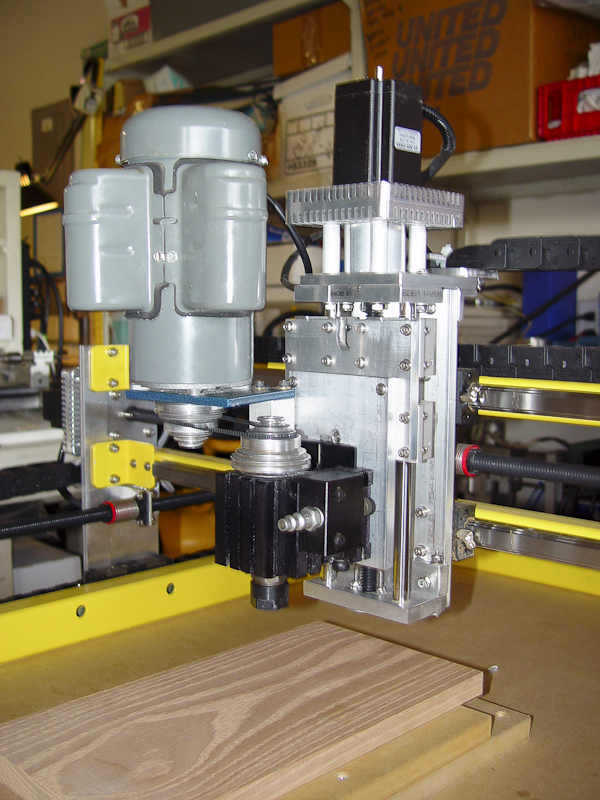

Here is the first look at making the mount and installing the Taig ER16 Spindle and continuous duty motor on the HB2. This is the same spindle and head that I use on the Taig CNC mill. In fact it IS the head FROM the Taig CNC mill.
I’ll be running a project tomorrow to test out the set up. If all goes well I already have the TAIG order made out for a new set-up exactly like this for full time use on the HB2. This is lower power than other spindles used on the HB2 but much quieter. From my experience using it for wood carving on the Taig mill, I think it will be just perfect for most work I do. I can fit up through a 3/8 inch cutting tool.
The ER spindle is far superior to the one in the little hand router. The big difference is sound level and the fact that the Taig spindle is 1/3 slower and 1/3 the power.
One thing to note though is there is the opportunity to select 6 different speeds. With the belt drive I always get full motor power as the motor is always running full speed.
The change over from one head to the other is about 30 minutes. It could be less but the one bolt in the center of the back-plate mount is a bugger to get started. It is between two linear bearings and behind the lead nut. I taped the nut to the wrench to get it started. 🙂
I will also post these pictures over in the THMS web site. That probably won’t be for a week or so. I am also considering doing a sound video so you all can see AND hear how she runs.
Project Tessa

In case you missed this, here is a picture of a project I made on the HB2 router. I published it over on the Ramblin’ Dan blog too.
The layout was designed in Vectric Aspire and output for the MACH3 controller. Of course it is MACH3 that runs the steppers on the HB2.
Four files and three tool bits were required. One file cuts the outline using a 1/4 inch flat router bit. It leaves tabs for support so I did this first. Next was the roughing file again with the 1/4 flat bit in 1/8 inch steps. The third pass was the finish (detailed) pass using a 1/8 inch ball nose bit with very shallow step over.
The last file was the V-Carve for the name and date.
Total run time on the HB2 was about 2.5 hours. Speeds were 100 IPM for the roughing and 70 IPM for the finish. The HB2 handled them all just fine.
I actually made three runs. The first one is where the coupling broke, the second I spelled Tessa’a middle name as Daniel (Horrors!) and then the final fully successful ran you see here. At least I had a test piece to practice the finish work (and I did).
Three coats of shellac gave the oak the color you see here (no stain). Then the color painting. Last a final coat of clear lacquer.
I also used a table router to cut a T slot in the back for hanging on the wall.
Oh yes, the date is correct. Tessa is one year old!