CNC
Taig ER16 Spindle Added to HB2


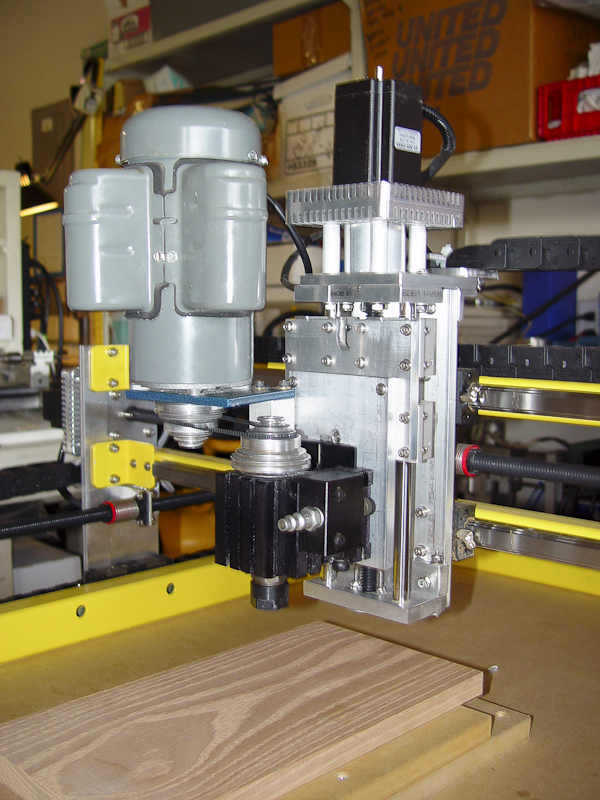

Here is the first look at making the mount and installing the Taig ER16 Spindle and continuous duty motor on the HB2. This is the same spindle and head that I use on the Taig CNC mill. In fact it IS the head FROM the Taig CNC mill.
I’ll be running a project tomorrow to test out the set up. If all goes well I already have the TAIG order made out for a new set-up exactly like this for full time use on the HB2. This is lower power than other spindles used on the HB2 but much quieter. From my experience using it for wood carving on the Taig mill, I think it will be just perfect for most work I do. I can fit up through a 3/8 inch cutting tool.
The ER spindle is far superior to the one in the little hand router. The big difference is sound level and the fact that the Taig spindle is 1/3 slower and 1/3 the power.
One thing to note though is there is the opportunity to select 6 different speeds. With the belt drive I always get full motor power as the motor is always running full speed.
The change over from one head to the other is about 30 minutes. It could be less but the one bolt in the center of the back-plate mount is a bugger to get started. It is between two linear bearings and behind the lead nut. I taped the nut to the wrench to get it started. 🙂
I will also post these pictures over in the THMS web site. That probably won’t be for a week or so. I am also considering doing a sound video so you all can see AND hear how she runs.
Next Product (and project)
I am working on a product for the CNC router folks. That includes me of course with my HB2 system. The one big pain in the ear for home and hobbyist is the screaming router noise for several hours (or more) at a time. I wear ear plugs but I am sure my neighbors are wondering why that high pitched motor whine noise, is running so long.
My solution is a simple adapter plate to mount the Taig ER spindle and motor to the HB2. Top speed is 10,600 rpm but that is not too bad for the up to 3/8 inch cutting bits I will normally be using. What I like is it features one of the best small collet systems in machining, the ER16 style.
I intend to offer the complete spindle setup in my web store. This will include everything (motor, spindle, pullys, etc.) to install it on the HB2 or any overhead router machine. Price will be < $350.00 USD.
Project Tessa

In case you missed this, here is a picture of a project I made on the HB2 router. I published it over on the Ramblin’ Dan blog too.
The layout was designed in Vectric Aspire and output for the MACH3 controller. Of course it is MACH3 that runs the steppers on the HB2.
Four files and three tool bits were required. One file cuts the outline using a 1/4 inch flat router bit. It leaves tabs for support so I did this first. Next was the roughing file again with the 1/4 flat bit in 1/8 inch steps. The third pass was the finish (detailed) pass using a 1/8 inch ball nose bit with very shallow step over.
The last file was the V-Carve for the name and date.
Total run time on the HB2 was about 2.5 hours. Speeds were 100 IPM for the roughing and 70 IPM for the finish. The HB2 handled them all just fine.
I actually made three runs. The first one is where the coupling broke, the second I spelled Tessa’a middle name as Daniel (Horrors!) and then the final fully successful ran you see here. At least I had a test piece to practice the finish work (and I did).
Three coats of shellac gave the oak the color you see here (no stain). Then the color painting. Last a final coat of clear lacquer.
I also used a table router to cut a T slot in the back for hanging on the wall.
Oh yes, the date is correct. Tessa is one year old!
Just Getting Better
The parts breaking seem to be behind me for now. I have run several very long 3D projects with no qualms from the HB2. It has just been rolling along doing it thing at fairly high speed (at least to me).
I have increased the MACH3 frequency to 60,000 Hz and now been able to run the steppers as high as 200 fpm (1000 rpm on the steppers) but not reliably. My rapids are now set at 150 IPM and that is as good as I’ll probably need. I was running the roughing at 100 IPM and the 2 hour finish passes were running at 70 IPM. Working just fine.
Ahhh… Life is good!
Going For Broke
Well, dumb me again. Sometimes I just have to learn by experience and just blame myself. I actually like problem shooting and it is something I usually do quite well. I should have been a CSI or some kind of forensic engineer.
My problem is I broke another coupling on the HB2. Same place and I am certain the same reason. There is nothing wrong with the selection or type of coupling. They are perfect for the work they were selected to do. Actually, the helical beam is one of the most rugged, with the highest torque and deflection ratings of the couplings I have researched.
My problem is shaft alignment. I am using the original slotted aluminum tubes around the couplers as debris covers. They have no affect on spacing or alignment. However, they did prevent me from clearly seeing, thus correcting my real problem on the Y axis steppers.
The first two axis I set up were X and Z. They were the easiest for me to measure and eyeball. They both have run super smooth. The double Y axis drive is what I did last and has been more of a problem. Since X and Z aligned so well, I ASSUMED assembling Y would be a no brainer. I put them together with the covers on and the open slot down. That made it extremely difficult for me to see the shaft misalignment. I used a mirror so I didn’t have to stand on my head to look up. However I couldn’t see the vertical alignment problem, only the horizontal which was fine. (The assume part.)
All the other work, end play, screw/guide alignment, was on the right track but not the major issue.
I am an energy and HVAC engineer. Motor coupling alignment is a major… Continue reading